
DockgeThis page
- Focus
- A fancy, easy-to-use and reactive self-hosted Docker Compose stack manager.
- Hosting
- Self-hostable
- License
- MIT
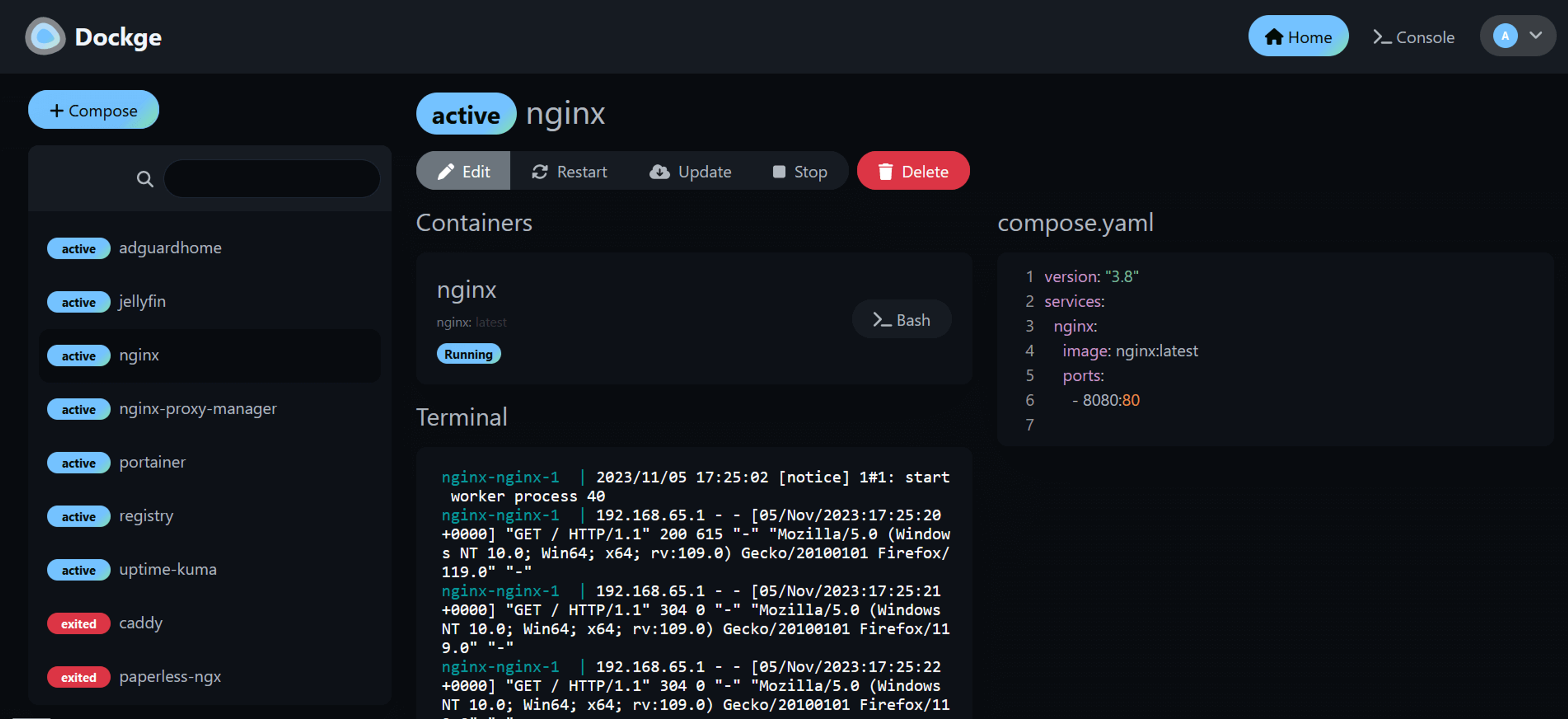

Pick it to manage compose.yaml stacks on one or two hosts with a clean UI, instead of Portainer's broader fleet features that now sit behind a paid tier.
Skip when you need a fully managed SaaS with zero operations work.
Browse all tools or SaaS alternatives on OpenElse.
Stable selection factors from this listing—focus, hosting, license, and access. Confirm live details on each official site.
| Dimension | Dockge | Portainer |
|---|---|---|
| Focus | A fancy, easy-to-use and reactive self-hosted Docker Compose stack manager. | Container management platform for Docker, Swarm, and Kubernetes with a paid Business Edition. |
| Hosting | Self-hostable | Commercial SaaS |
| License | MIT | Proprietary (typical SaaS) |
| Access | Website + GitHub | www.portainer.io |
Dockge is an open-source Container Management project. A fancy, easy-to-use and reactive self-hosted Docker Compose stack manager. OpenElse lists it as an alternative to Portainer, with self-hostable deployment and MIT licensing. Confirm live features, hosting options, and terms on the official site and repository.
Core signals from this OpenElse listing—verify depth on the official site.
Source is published on GitHub at github.com/louislam/dockge.
You can run it on your own infrastructure.
Distributed under MIT. Read the license text before production use.
OpenElse tags this listing for docker, docker-compose, portainer, stacks.
Mapped as an open-source option when evaluating replacements for that commercial product.
A practical path from this directory page to a decision.
Review the one-liner, self-host status, license, and “when to pick it” note for Dockge.
Visit dockge.kuma.pet for product docs, demos, and current feature scope.
Use GitHub for release cadence, issues, stars, and deployment docs before you commit.
Open other OpenElse tools in the same category or mapped to the same SaaS to see trade-offs.
Pick it to manage compose.yaml stacks on one or two hosts with a clean UI, instead of Portainer's broader fleet features that now sit behind a paid tier.
Dockge is listed as self-hostable on OpenElse.
Self-hostable Docker and container managers instead of Portainer-style commercial platforms.
Pick it to manage compose.yaml stacks on one or two hosts with a clean UI, instead of Portainer's broader fleet features that now sit behind a paid tier. Skip when you need a fully managed SaaS with zero operations work.
Facts to verify on the official site before you depend on a workflow.
Quick answers about this listing—open a question to read more.
Yes. OpenElse lists Dockge as an open-source project under MIT. Review the license file in the repository for exact terms.
Yes. OpenElse marks Dockge as self-hostable. Follow the official docs for install and operations.
Dockge is mapped on OpenElse as an open-source alternative to Portainer. Pick it to manage compose.yaml stacks on one or two hosts with a clean UI, instead of Portainer's broader fleet features that now sit behind a paid tier.
No. This is a OpenElse directory page. The official site is https://dockge.kuma.pet, and the source repository is https://github.com/louislam/dockge.
The public repository linked from this listing is https://github.com/louislam/dockge.